PatternsNo. 03 · Polygonal
No two blocks alike, and no mortar anywhere.
Many-sided stones cut to fit each other rather than to a standard. No vertical joint runs the height of the wall, so when the ground moves the wall flexes instead of failing.
84 sites · 21 countriesEquirectangular · every dot is a site in the Atlas
Watch the comparison · 6 studies
 Polygonal walls of the giants in ancient Italy — AlatriHugh Newman / MegalithomaniaItaly
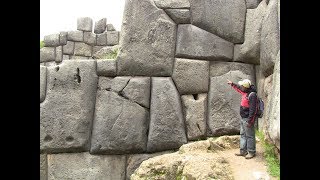 Megalithic Peru — exploring the evidence around CuscoBrien FoersterPeru · the 200-ton corner stones
 Meydan Kalesi — giant polygonal and cyclopean wallsHugh Newman / MegalithomaniaTürkiye
 Megalithic technology in ancient TongaHugh Newman / MegalithomaniaTonga · the Pacific end of the pattern
 Phimai temple — the greatest mystery of ThailandPraveen MohanThailand
 Reassessing ancient CambodiaSecrets in StoneCambodia
Six walls, six countries, no contact between any of them.
What the pattern is, and what it is not: the argument in full
Square your stone and you can stack fast, but the courses run straight through and that is exactly where a wall fails when the ground moves. Fit each block to its neighbours and the empty joints act as energy sinks. That is the practical reason the technique recurs on five continents.
What it doesn't explain is the tolerance at the top of the range, or joint faces that curve in two directions so a block cannot be lowered straight in along any axis.
Every site in the Atlas that carries it · 84 across 21 countries
Bosnia and Herzegovina
Cambodia
Ethiopia
Greece
Israel
Italy
Lebanon
Oceania
Peru
Syria
Thailand
The other patterns
Dimmed patterns are tagged across the Atlas but have no comparative study written yet.