More than a thousand survive in the British Isles alone. They were instruments long before they were ruins : : calendars, meeting places, sound chambers, and proofs that Pythagorean geometry was practiced two thousand years before Pythagoras.
The standard tourist phrase is "ancient ritual site." It is technically true and almost entirely useless. The stone circles of Britain, Brittany, Scandinavia, the Levant, and beyond were precision-engineered to do specific work : : tracking solstices, predicting eclipses, marking the lunar standstills that recur on a 18.6-year cycle, recording units of measurement, and (where the geophysics has been done) producing acoustic and electromagnetic effects no one can yet fully explain. The lens this entry builds is the difference between seeing "old rocks in a field" and seeing instruments that took centuries to design and millennia to forget.
Six properties recur across the strongest sites in the catalog. Hold them in mind:
Read end to end, or pull any one thread. The entry stands on its own, and the sections do too.
Every account of the stone circle tradition has to begin with the same site, for the same reason : : it is the deepest stratum we have. Göbekli Tepe, on a hilltop near Şanlıurfa in southeastern Türkiye, was building monumental circular enclosures of T-shaped megalithic pillars roughly 11,500 years ago. That is 6,500 years before Stonehenge. 7,000 years before the Pyramids. 5,000 years before the agricultural revolution conventional history treats as the prerequisite for monumental construction. Göbekli Tepe is the falsification, in stone, of the "settled agriculture first, monuments later" narrative.
The catalog of what is already present at the site is striking. Up to 60 circular enclosures, the largest 65 feet across. T-pillars 10 to 20 feet tall, weighing 10 to 20 tons each, with the largest unfinished pillar still in the quarry at 24 feet. Carved animal reliefs (lions, scorpions, boars), abstract human figures wearing belts with enigmatic H and U glyphs, and astronomical alignments embedded in the construction. Engravings on the so-called Vulture Stone may be the earliest known representations of constellations, including Cygnus. Several of the oldest enclosures point toward the precessional position of the pole star at the date of construction, suggesting a 25,800-year astronomical awareness encoded thousands of years before any culture is supposed to have had it.
The pattern that recurs across the rest of the catalog applies here too, and harder than anywhere else: the oldest enclosures at Göbekli Tepe are the largest and most sophisticated. Later phases of the site are smaller, cruder, and use poorer-quality stone. Around 8,000 BCE the entire complex was deliberately buried under earth. The decision was made by people who had inherited it and chose to seal it. Why is one of the open questions the rest of this entry circles back to.
The deepest layer is the best work.
Alexander Thom's survey work (covered in detail in §05) demonstrated that the megalithic tradition built five distinct geometric forms, only one of which is a true circle. The rest are deliberately distorted, and the distortions are precise. Knowing the type tells you what the builders were doing.
A fifth form, the compound circle, is occasionally seen: multiple radii joined at tangent points, creating a smooth but deliberately non-uniform perimeter. Thom found at least a dozen examples. The distinction is not aesthetic. It changes which astronomical alignments are possible from which marked stones around the ring. Every variant solves a different observational problem.
The case that stone circles were observational instruments was first made publicly by Sir Norman Lockyer (1836–1920), the founder of Nature magazine and the man who discovered helium in the spectrum of the sun. Lockyer surveyed Stonehenge in 1901 and demonstrated that the structure was aligned to the summer solstice sunrise with sub-degree precision. He was dismissed for decades by establishment archaeologists who preferred ritual explanations. He has since been almost entirely vindicated.
The alignments documented across the British megalithic corpus include all of the following, depending on the site:
The conventional skeptical move is that any old structure can be retro-fit to some astronomical event, given enough freedom to choose. Lockyer, Hawkins, and Thom all addressed this directly: the alignments at the surveyed sites are not statistically explained by chance. They cluster too tightly on the small set of astronomically meaningful directions. The argument is settled in the surveyed corpus. The remaining question is what to make of it.
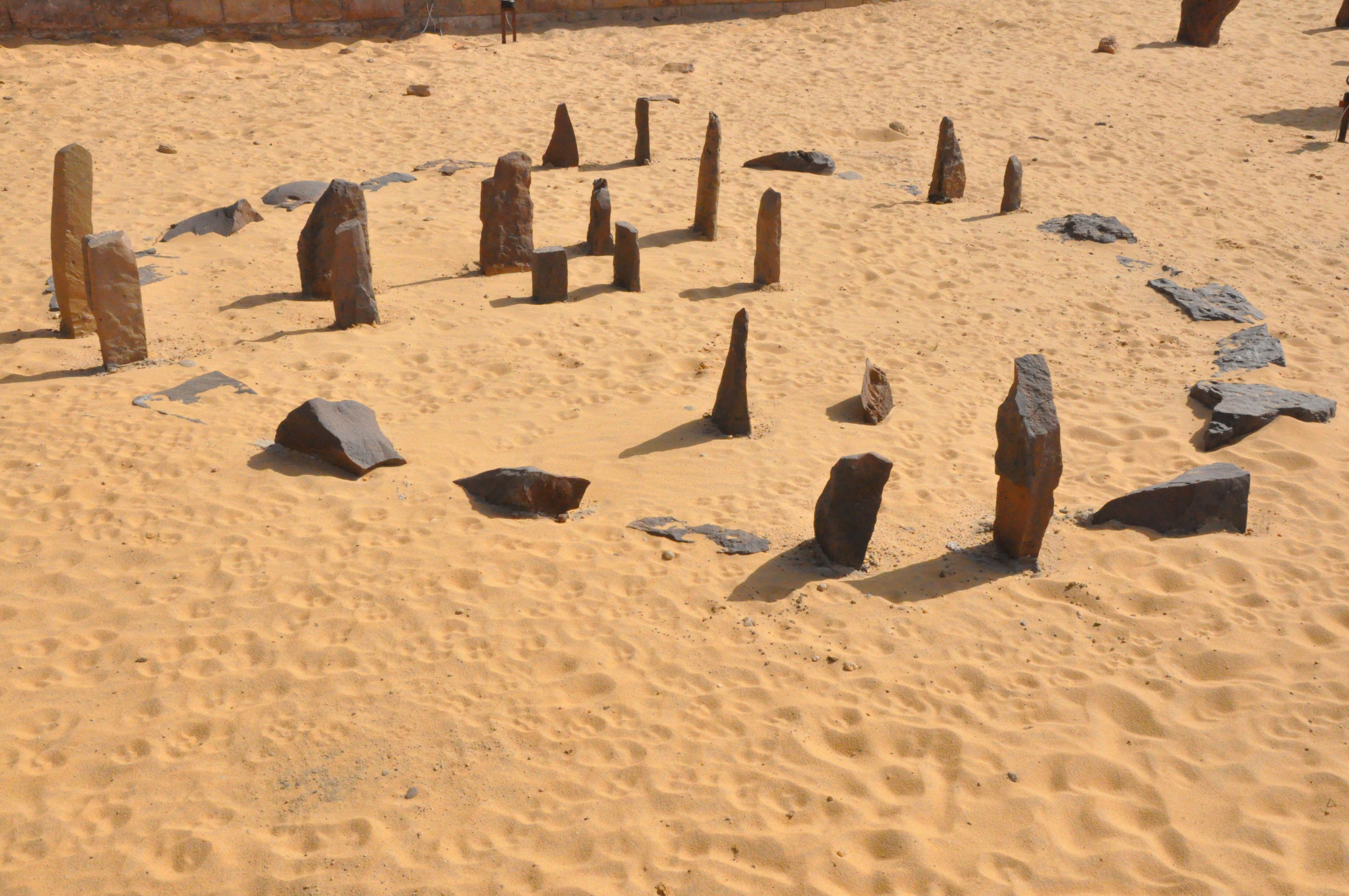
And the surveyed corpus is not where the practice begins. The oldest known astronomical stone circle is not in Britain. It is in the Sahara.
The most rigorous evidence for a coordinated megalithic tradition comes from a Scottish professor of engineering science, Alexander Thom (1894–1985). Working from 1957 to 1985, Thom personally surveyed over 500 stone circles across Britain, Ireland, and Brittany, with the precision of his professional discipline. The results are published in three books: Megalithic Sites in Britain (1967), Megalithic Lunar Observatories (1971), and Megalithic Remains in Britain and Brittany (1978).
Thom found four things the standard archaeology of his time was unprepared for:
First, a common unit of measurement. Across his entire surveyed corpus, distances and diameters recurred in whole multiples of 2.72 feet (0.829 meters). The pattern was statistically significant beyond reasonable doubt. He called the unit the megalithic yard. The 2.5-multiple, ~6.8 feet, he called the megalithic rod. The fact that an unwritten Bronze Age population, scattered across hundreds of thousands of square miles over more than a thousand years of construction activity, somehow shared a standard unit to within a few percent is the part later researchers have most struggled to explain. Thom himself suspected coordinated transmission of a measuring rod.
Second, Pythagorean geometry. Roughly one third of Thom's surveyed "circles" turned out to be precise constructions based on 3-4-5 triangles, 5-12-13 triangles, and other Pythagorean ratios. The construction was being practiced in stone two thousand years before Pythagoras of Samos was born.
Third, lunar precision. Multiple sites included observational baselines tuned to the 18.6-year lunar standstill cycle to within minutes of arc. To detect that cycle at all requires an unbroken observational record across at least one full standstill period. The implication is multi-generational coordinated record-keeping in a pre-literate culture.
Fourth, landscape integration. Many of Thom's circles use distant horizon features (notches between hills, conspicuous boulders, the rise of a distant ridge) as their actual sighting line, with the stones serving as the foreground reference. The circles were the foresight; the landscape was the backsight. The "site" extended for miles.
None of Thom's four findings has been refuted. Archaeology has, in places, declined to engage with them. The megalithic yard remains the cleanest single piece of evidence that the British and European megalithic builders were a coherent technical culture, not a scattered population of locals each doing their own thing.
The strongest single Pythagorean construction in the corpus is at Le Menec at Carnac, surveyed by Howard Crowhurst and others. The Le Menec cromlech is built on two back-to-back 3-4-5 right triangles forming a Type 1 Egg, with a well at the geometric center. Eleven separate alignments of standing stones radiate outward from the cromlech, the longest extending over a kilometer across the Breton landscape. The triangle's angles are oriented to specific astronomical positions. The math is exact, the geometry is intentional, and the date is roughly 4,500 BCE : : two thousand years before the first known written reference to the 3-4-5 relationship in the Babylonian tablets, and roughly the same gap before Pythagoras taught it as a theorem.
The interpretive options are limited:
(1) Independent rediscovery of the relationship by multiple Neolithic cultures.
(2) A continuous transmission of a much older body of geometric knowledge that the Pythagorean Greeks were the inheritors of, not the originators of.
The Pythagoreans themselves were explicit on the matter. They credited their geometry to earlier sources : : the Egyptians, the Babylonians, and a vague but recurring reference to "the priests of the deep past." Pythagoras did not claim to have discovered the theorem. He claimed to have systematized it. The stone circle record supports the second option more readily than the first.
The British Isles preserve the densest concentration of surviving stone circles in the world, more than a thousand documented examples between roughly 3,500 BCE and 1,500 BCE. They are not the only ones. The practice appears on every continent that had stone and population, often with no plausible mechanism of contact between the practitioners.
The American continents have less surviving evidence (the Wheel of Bighorn Medicine in Wyoming is the most studied case, late Holocene), and Australia preserves the Wurdi Youang circle near Melbourne, possibly the oldest astronomical observatory in the world if the dating holds. The practice was nearly universal. The interpretation, in every culture, included calendrical timekeeping and spiritual gathering. The technical sophistication varied. The British and Breton corpus is the densest single sample.
From the 1970s onward, a small group of researchers ran instrumented surveys at stone circles, looking for measurable physical effects. The results have not entered mainstream textbooks but they are reproducible. Two categories of phenomenon recur:
Folk memory at many British rings preserves the same observations long before any instrumented survey: T. C. Lethbridge reported being electrically shocked when he touched stones at the Merry Maidens in Cornwall. Horses at Scorhill on Dartmoor and at Avebury (1823) reportedly refused to enter the rings. Men-an-Tol in Cornwall has a long history as a healing stone for sick infants. These are anecdotes, not evidence. They do, however, line up with what the instruments now measure.
The honest editorial position is the same as everywhere else on this page: the phenomena are documented, the mechanisms are not fully understood, and the standard "ritual site" framing fails to account for them. Either the builders selected their sites carefully for physical properties they had detected by means we no longer practice, or there is a body of geophysics that ancient builders understood and we have not yet recovered. Both options are open.
"What were the stone circles for?" is the question every visitor asks, and the assumption baked into the question is that there must be one answer. The evidence supports a different assumption: the circles served several distinct purposes simultaneously, and the same site was used differently at different times.
Calendar. The alignments demonstrate calendrical function across most of the surveyed corpus. The annual cycle (solstices, equinoxes) and the lunar standstill cycle were tracked. This was useful work for a Neolithic farming population that needed to predict planting and harvest dates.
Gathering place. Archaeological evidence at Durrington Walls (next to Stonehenge) shows that thousands of people travelled from across Britain to feast at the winter solstice. Compacted earth inside many smaller rings supports folk memories of dancing and ceremony. The stones marked a social calendar, not just an astronomical one.
Court of judgement. Boscawen-Un in Cornwall served as a gorsedd, a place of judgement where tribal leaders settled legal matters, into the 7th century CE. The practice may be much older. Several sites carry similar place-names.
Acoustic instrument. The rings amplify, sustain, and locate the human voice in ways that no naive arrangement of stones could produce. Whatever ceremony took place at them seems to have been designed for an acoustic environment that the architecture provided.
Geophysical instrument. The telluric and electromagnetic measurements suggest that some sites were sited on, or designed to interact with, specific subterranean conditions. The hypothesis that the builders used these properties to influence biological systems (seed germination, healing, altered states) is unproven but consistent with the measurements.
All five purposes overlap in time and at the same sites. The right question is not "what was it for" but "what wasn't it for." The instruments did multiple things at once. This is also how modern instruments work : : a telescope is also a teaching device is also a museum piece is also a community asset. The circles were the same.
The diagnostic moves to make when standing inside a stone circle:
Count the stones and look at the type. If the count is unusually exact (12, 19, 28, 56), suspect a calendrical or eclipse-prediction function. Use the §03 typology to identify whether the ring is a true circle, a flattened circle, an egg, or an ellipse. The geometry tells you what the builders were doing.
Stand at the center and find the foresight. Most aligned circles have one or two stones marking specific directions. Find the tallest, the most isolated, or the one set in a notable spot off to the side. These are usually the alignment stones. The targeting direction will often be to a distant horizon feature, not to the nearest hill.
Strike a stone and listen. If the ring's stones are granite or igneous rock, they will often reverberate when struck with the open hand. The longer the tone, the more carefully the stone was chosen. The most "rung" stones in a circle are usually the ones at the alignment points.
Walk the perimeter. Look for spacing irregularities, doubled stones, or unusual gaps. These often mark the lunar or eclipse-related positions that the seasonal solar alignments alone do not account for.
Apply the frame to the atlas. Open the map →
Suggest additions or corrections through the Contact form.