Ancient Atlas
A map of the deep past
← Library
Library · Entry 01

What is a megalith?

A working vocabulary of deep stone : : the words you need before you can compare the work the world's oldest builders actually did.

§ 01 · The frameOnce you have the vocabulary, the past reorganizes itself.

A megalith is not just a big stone. It is a deliberate act of engineering whose scale, joinery, finish, and placement force a question modern history is still working out how to answer. The vocabulary on this page is the difference between seeing a "big rock" and seeing a system. By the time you reach the bottom of this entry, the atlas reads differently. Sites you scrolled past begin to disclose themselves.

Six properties tend to repeat at the most demanding sites in the catalog. None of them is decoration. Each one is a question worth holding in mind while you read:

Read end to end, or follow any one thread down and back. The page is built so the parts also work in isolation.

The root

Megalith comes from Greek: mega (great) and lithos (stone). The literal sense is just "big stone." The technical sense is narrower and more useful: a megalith is a stone, or a structure made from stones, large enough that its handling, shaping, and placement cannot be casually explained by ordinary human labor. Where casual ends and extraordinary begins is exactly where this lexicon lives.

Two further distinctions matter. A monolith is a single stone, worked or unworked, that stands alone or has been shaped from one piece. The Aswan Obelisk would have been a monolith. The Easter Island moai are monoliths. A megalithic structure is many large stones assembled into something, usually without mortar. Stonehenge is megalithic. The walls of Sacsayhuamán are megalithic. The Baalbek trilithon is both: three monoliths arranged into a megalithic foundation.

The third distinction is the one most readers miss. Mortarless does not mean unfinished or primitive. It means precise. Stones cut to fit each other directly, edge to edge, with tolerances often tighter than what modern masonry achieves with mortar to forgive the gaps. The skill is not in the size. The skill is in the joinery.

§ 02 · LexiconThe terms you'll see most often.

Each of these words names a specific phenomenon. Confusing them flattens the work. Distinguishing them sharpens what you notice.

Cyclopean
/saɪˈkloʊ.pi.ən/
Massive irregular blocks, often unfinished on their outer face, fitted without mortar. Named by the ancient Greeks, who could not believe their Bronze Age ancestors had built the walls of Mycenae and assumed the Cyclopes had done it.
Polygonal
/pəˈlɪɡ.ə.nəl/
Many-sided stones, each cut to interlock with several neighbors, joined without mortar. The blocks may be enormous, the seams are typically razor-tight, and the geometry rarely repeats. The Cusco pattern, but also Japanese castle walls and parts of Easter Island.
Trilithon
/ˈtraɪ.lɪ.θɒn/
Three stones: two uprights and a horizontal lintel. The most efficient possible monumental form. Stonehenge made it iconic. Baalbek made it impossible, with three lintel-equivalents weighing roughly 800 tons each, set 22 meters above the ground.
Ashlar
/ˈæʃ.lər/
Cut stone shaped into rectangular blocks with squared faces and uniform courses. Visually the calmest of the masonry types. Egypt's pyramid casing, the upper courses of Inca temples, and most Greek architecture work in ashlar.
Monolithic
/ˌmɒn.əˈlɪð.ɪk/
Carved from a single block, however large. The Great Sphinx is monolithic. So is each Easter Island moai. So is the Kailasa Temple at Ellora, which is somehow a complete multi-story temple sculpted downward out of one mountain face.
Megalith vs Menhir vs Dolmen
/ˈmɛɡ.ə.lɪθ/ /ˈmɛn.hɪər/ /ˈdɒl.mɛn/
A menhir is a single upright stone standing alone (think Carnac in France). A dolmen is a portal tomb: two or more uprights capped by a horizontal slab. Both are subsets of megalithic construction. The terms come from Breton.
See: Carnac, dolmen fields across the Atlantic façade and Korea.
T-Pillar
/tiː ˈpɪl.ər/
Anthropomorphic monolith carved into a stylized "T" silhouette, often with carved arms, belts, and animal reliefs along the sides. The defining form of Göbekli Tepe and Karahan Tepe in southeastern Türkiye. The world's oldest known monumental architecture, roughly 11,500 years old, predating Stonehenge by 7,000 years and the Pyramids by 7,000 years. The site contains as many as 60 stone enclosures, and the rule that recurs across the whole catalog applies here too: the oldest rings are the largest and most sophisticated. The deepest layer is the best work.
Anastylosis
/ˌæn.əˈstaɪ.lə.sɪs/
The archaeological practice of rebuilding a ruined monument using only its original surviving material, fitting the rediscovered blocks back into their inferred positions. Most "intact" megalithic sites you walk through have undergone partial anastylosis. The skill of the reconstruction often determines how much of what you're reading is original.
Widely used at Stonehenge, Knossos, and across the Khmer corpus.

"The skill is not in the size. The skill is in the joinery."

§ 03 · MortarThe rule, and the four telling exceptions.

"Usually without mortar" is doing a lot of work in the definitions above. The honest answer is that the most demanding megalithic sites in the world were assembled dry: stone on stone, no binder, the geometry of the cut doing all the load transfer. The work survives 6,000 to 12,000 years of seismic stress because the joinery is the structural system. Mortar would have been a confession of imprecision. The builders did not confess.

The clearest test is the knife-blade test, and visitors at Sacsayhuamán, Ollantaytambo, and Cusco's downtown walls have been performing it for 500 years. A modern credit card cannot be inserted into the seams of the lower-course polygonal blocks. A piece of paper, in many places, gets you stopped a millimeter in.

And yet : : mortar does appear in the ancient record, just rarely at the demanding tier. The four cleanest examples:

Rome (and the empire's reach)
Pozzolana concrete
The Romans made one of the most durable mortars in history by combining volcanic ash from Pozzuoli with lime and seawater. The Pantheon dome and the upper structures at Baalbek's Roman period rest on it. The trick is that Roman concrete improves with time : : it self-heals as seawater interacts with the lime. Modern Portland cement degrades in centuries; the Roman walls have not.
Mesoamerica
Maya lime mortar & stucco
At Tikal, Palenque, Calakmul, and Copán, the Maya used a lime-and-sascab mortar between limestone blocks, often coated in thick lime stucco. The mortar gave them broad architectural freedom (corbel vaults, large interior spaces) but it also dates the work : : the lime-bearing surfaces are easy to read against stratigraphy.
Egypt
Gypsum as a lubricant, not glue
The Egyptians used gypsum mortar between Great Pyramid casing stones and at certain dynastic temples. The function was not adhesion : : modern study (Lehner, Edwards) suggests it acted as a lubricant that let masons slide each block into final position before the gypsum set, locking the dry joint at maximum tightness. Once cured, the mortar provided almost no shear resistance. The joinery still does the work.
Andes (late Inca)
Mud infill on the upper courses
The Inca, building onto earlier polygonal foundations they had not made, often used clay or mud infill behind the visible ashlar of their upper courses. The deep foundations stayed dry-fit. The new walls above used the easier method. Reading both at the same site is one of the clearest ways to see the two-period pattern at Cusco, Pisac, and Ollantaytambo.

What about Göbekli Tepe, the oldest megalithic site in the world? The T-pillars (~11,500 years old, some weighing 10–20 tons) are set into the bedrock and stabilized with compacted earth and small packing stones. No mortar. The technique is the same one used at Ollantaytambo eight thousand years later. Mortar is not what made megalithic construction durable. Geometry is.

A modern footnote worth keeping in mind. From 1923 to 1951, a 5-foot-tall Latvian immigrant named Edward Leedskalnin built Coral Castle in southern Florida — a complex of multi-ton coral-limestone megaliths, including a 9-ton swinging gate balanced so precisely it could be pushed with a finger. He worked alone, at night, with no power tools, no helpers, and no witnesses. He took his methods with him. The standing claim "we know how the ancients did it" has to share the floor with the standing fact that we don't actually know how Leedskalnin did it last century. The capacity to move stone without industrial equipment is not as lost as the textbooks assume.

§ 04 · HardnessThe Mohs scale, and why it changes the question.

Friedrich Mohs proposed his ten-point hardness scale in 1812. The scale is ordinal, not linear: a mineral scratches anything below it on the list, but the actual hardness gap between rungs widens dramatically at the top end. The visualization below makes the difference visible. The blue bar is the rank. The gold bar is the real-world scratch-resistance, measured against the same reference. Notice how the gap between 9 and 10 dwarfs the entire bottom half of the scale.

Ordinal rank (linear) Real scratch resistance (exponential)
The Mohs scale tells you the order. It deliberately does not tell you the magnitude. Granite (Mohs 6–7) is roughly forty times harder than gypsum (Mohs 2). Diamond (Mohs 10) is roughly forty times harder than corundum (Mohs 9). Each new rung at the top is a different universe of difficulty.

Most casual readers assume the ancients worked stone the way modern stonemasons do: slowly, with chisels, over years. That intuition works for limestone and sandstone, which are soft. It does not survive contact with granite, basalt, diorite, or quartzite. Those stones are roughly as hard as steel. Working them with copper or bronze tools should not produce the precision the surviving evidence shows, and yet the evidence shows it.

1
Talcscratched by a fingernail
Soapstone
2
Gypsumfingernail scratches it
Alabaster, salt
3
Calcitecopper coin scratches it
Limestone, marble
4
Fluoritescratched by knife
Most weathered sandstones
5
Apatiteknife with difficulty
Tuff, some volcanic stone
6
Orthoclasesteel file scratches it
Basalt, andesite, granite
7
Quartzscratches steel
Diorite, quartzite, hard granite
8
Topazscratches quartz
Industrial cutting only
9
Corundumsapphire, ruby
Gemstones, abrasives
10
Diamondscratches everything
Modern cutting heads

The atlas's most demanding sites work in stone above Mohs 6. The Aswan obelisks, the Ramesseum colossi, the Cusco lower courses, the Yangshan stele: all granite, andesite, or diorite. Once you know the hardness, the achievement gets harder to wave away as "just primitive labor scaled up." Time alone does not get a copper chisel through granite. Something else was happening, and the honest position is that we are still working out what.

§ 05 · WeightThe heaviest stones ever moved.

This list ranks stones that were quarried, transported, and set in place. Stones that were started but never moved (the Yangshan stele in China at ~16,000 tons, the Stone of the South at Baalbek at ~1,650 tons) are noted as a separate category at the bottom: the things they almost did. The list is calibrated to what historians and engineers can defend, which means several long-circulating numbers (the Trilithon at "1,000 tons each," etc.) appear here at their more conservative estimates.

№ 01

Ramesseum Colossus (Egypt)

Statue of Ramses II at his mortuary temple in Thebes. Carved from a single block of granite and transported from Aswan, roughly 270 km upstream. Now broken; the head and torso fragment alone weighs hundreds of tons.
~1,000tons
№ 02

Baalbek Trilithon (Lebanon)

Three monolithic blocks in the foundation of the Roman Jupiter temple, set six courses up at roughly 22 meters above grade. Each block measures approximately 19 × 4 × 4 meters.
~800tons each
№ 03

Colossi of Memnon (Egypt)

Two seated statues of Amenhotep III, quarried near Cairo and transported ~675 km south to Thebes against the Nile current. Each stands roughly 18 meters tall.
~720tons each
№ 04

Western Stone, Jerusalem

A foundation block in the Western Wall of the Temple Mount. Approximately 13.6 × 3 × 3.3 meters. Set in place during Herod the Great's expansion, ~20 BCE.
~570tons
№ 05

Ollantaytambo Wall of Six Monoliths (Peru)

Six tightly-jointed rose-granite slabs forming a single wall on top of the temple mountain, quarried from a mountain across the Urubamba Valley.
50–80tons each
№ 06

Sacsayhuamán largest block (Peru)

The biggest stone in the zigzag lower wall. Polygonal, granite, fitted to perhaps a dozen neighbors. The wall sits above Cusco at 3,700 meters.
~125tons
№ 07

Osaka Castle Octopus Stone (Japan)

The Takoishi, the largest single block in the castle's main wall, quarried on Shōdoshima island and floated 60 km across the Inland Sea in the early 1600s.
~130tons
№ 08

Lion Gate Lintel (Mycenae)

The horizontal slab spanning the main entrance to the citadel at Mycenae, surmounted by the iconic lion relief. Limestone, ~Late Bronze Age (~1250 BCE).
~20tons
№ 09

Paro (Easter Island)

The largest moai ever raised on an ahu platform, on the northeast coast of Rapa Nui. Quarried at Rano Raraku and transported by means still actively debated.
~82tons
№ 10

Stonehenge Sarsen Stones (England)

The outer ring's vertical sarsens, with their lintels still spanning two adjacent uprights. Quarried at West Woods, transported ~25 km south.
25–40tons each

What they almost did

Two stones outrank everything above, but they never moved. The Stone of the South at Baalbek (Hajar al-Hibla, "the Stone of the Pregnant Woman") sits in the quarry still attached at one corner, weighing roughly 1,650 tons. A third Baalbek block found buried beneath it in 2014 may be even heavier, perhaps 1,800–2,000 tons. The Yangshan Stele in China was cut from solid bedrock as a single piece intended for the tomb of the Yongle Emperor (1402–1424 CE). It would have weighed roughly 16,250 tons. It was abandoned in place after the engineers concluded it could not be moved. Both are reminders that the upper limit of what ancient quarrymen attempted was much higher than the upper limit of what they actually transported.

What modern equipment can do

The Baalbek trilithon (each block ~800 tons, placed at 22 meters above grade) sits right at the upper edge of what today's heaviest construction equipment can lift, and beyond what most projects ever attempt. The reference table below also makes the historical point: every machine in the modern column was introduced within the last 20 years. Before 2007, no crane in production could lift a Baalbek trilithon block. Before 2010, no production crawler could match what the Romans (or whoever built the foundation) did in stone at 22 meters.

Introduced 2010Liebherr LR 13000 (crawler crane)
~3,000 t
The largest production crawler crane in the world today. Used in petrochemical and nuclear construction.
Introduced 2007Liebherr LTM 11200-9.1 (mobile)
~1,200 t
The largest mobile (rubber-tired) crane in production. Highest practical load on a road-moveable platform.
Introduced 2018Mammoet PTC 200-DS heavy-lift
~5,000 t
A purpose-built ring crane requiring weeks of assembly. Used only on major industrial projects.
Baalbek Trilithon (each block)
~800 t
Placed at 22m height on a finished masonry foundation. Within the LR 13000's capacity. Pre-Roman date contested.
Stone of the South (Baalbek quarry)
~1,650 t
Half-cut from the bedrock. Within the PTC 200-DS's specialized ring-crane capacity if it could be rigged, which it cannot be at the quarry site.
Yangshan Stele (China quarry)
~16,250 t
Roughly five times heavier than the largest crane in existence. Abandoned in place by its Ming-era engineers for the same reason.

The precision question

The weight, on its own, is a problem. The weight plus the precision is the deeper one. Many of the largest blocks in the catalog were not just moved : : they were finished to fit their neighbors with tolerances tighter than modern industrial masonry achieves.

Three observations about the work pattern recur across the most demanding sites, and they sharpen the puzzle:

The paper test. At Sacsayhuamán, at Ollantaytambo, at the Twelve-Angled Stone in downtown Cusco, at Osaka Castle's main wall, at the Lower Tier of Karahan Tepe: a piece of paper, slid against the seam between two polygonal blocks, will not enter. Some sections refuse even a thinned razor blade. This is not figurative. It is the standard tourist demonstration. The stones meet each other directly, with no gap to plug.

Transported rough, finished in place. The most demanding Andean walls were not pre-cut to a final shape at the quarry and then assembled. The evidence (asymmetric block geometries, locally-customized joint geometry, in-situ tool marks on the contact faces) suggests the stones arrived rough, and the final shaping happened against the actual neighbors after delivery. Each face was cut to its specific partner, not to a generic plan. This is wildly more difficult than dry-stack assembly and changes what kind of process must be inferred.

The same signature appears at Giza. The lower courses of Khafre's pyramid and the surviving granite casing on Menkaure's are wrapped in rose granite quarried at the Aswan quarry, transported ~900 km down the Nile, and set against the pyramid core. The blocks have a characteristic cushioned, pillow-shaped outer face : : rounded, irregular, conspicuously not pre-cut to a uniform plan. The seams between them, however, are razor-tight, each one individually shaped to match its specific neighbor's curvature. The only way to produce that combination is to deliver rough blocks and finish the cushion face against the in-place neighbors. The same in-situ joinery method that produced the Cusco walls produced the granite casing at Giza, on a different continent, by a different culture, with no plausible mechanism of contact between them. The pattern is not regional. It is technological.

Rose-granite specifically. Many of the Andean polygonal foundation blocks are rose granite, Mohs 6–7, harder than the steel chisels we know the Inca did not have. Sacsayhuamán's largest stones are quarried from Rumiqolqa, several kilometers away across a valley. They were transported, shaped to fit unique adjacent geometry on site, and finished to paper tolerance. With copper-bronze tools and stone hammers, according to the official account. The granite at Khafre and Menkaure is the same material, finished with the same method, by a culture that supposedly never met the one in the Andes.
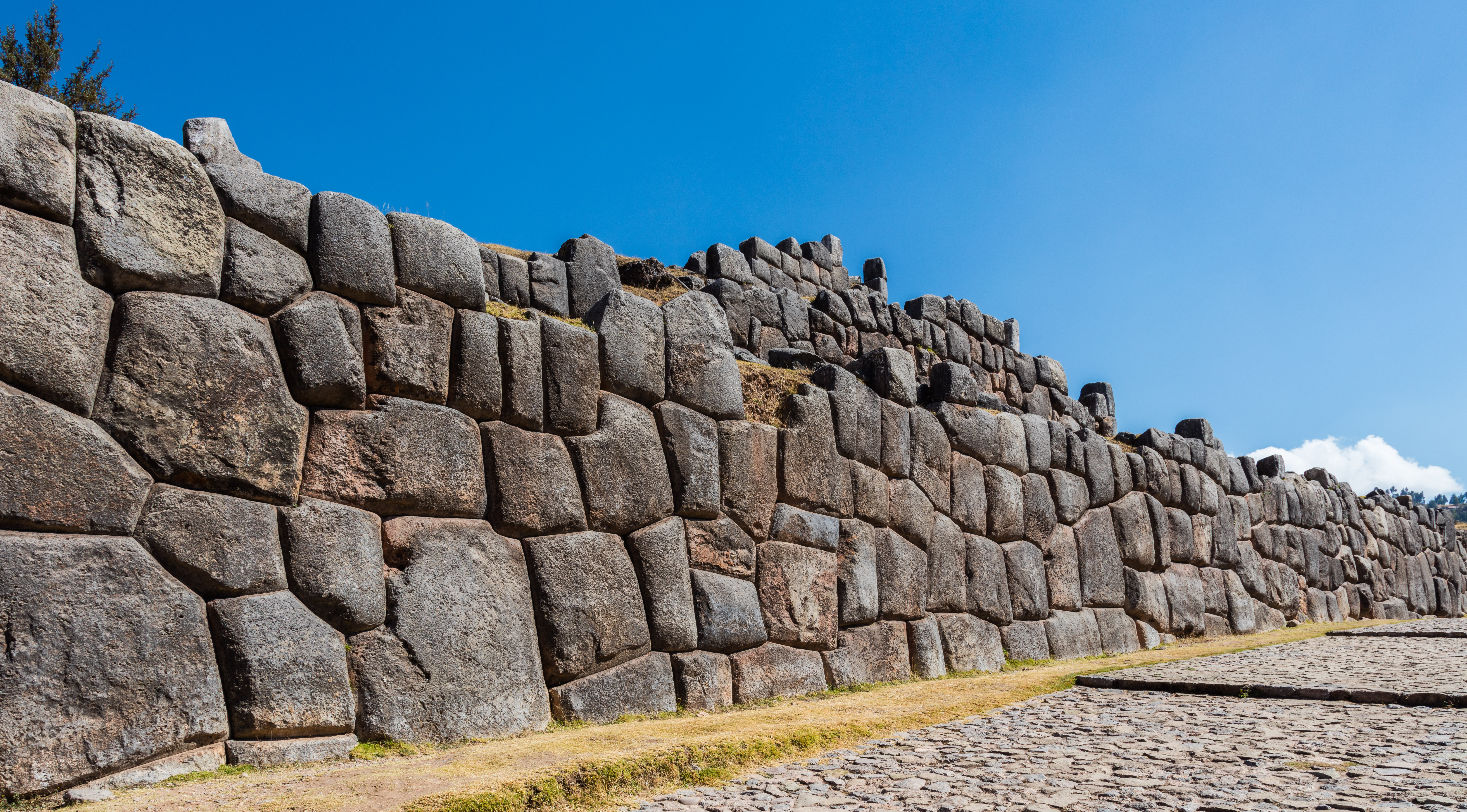
"Time alone does not get a copper chisel through granite. Something else was happening."

§ 06 · The pattern that repeatsThe wall as a Platonic form.

Plato proposed that ideal forms exist independently of their specific cultural expressions : : a triangle remains a triangle whether drawn in Athens or Cusco. The premise is hard to apply to most of human-made history, where local style and material dominate. It is unusually easy to apply to the megalithic wall. There is something like an ideal polygonal wall, an abstract form characterized by many-sided blocks meeting at custom-cut seams, mortarless, at scale. The expression of that form varies by culture, era, and material. The form itself recurs. Four cultures, on four continents, with no plausible mechanism of contact, built variants of the same wall.

South America · Sacsayhuamán, Cusco, Peru
The lower outer wall at Sacsayhuamán above Cusco: massive polygonal andesite blocks fitted without mortar, many of them with seven or more sides, weathered grey-gold under a deep blue Andean sky.
The canonical wall. The lower outer terrace at Sacsayhuamán, on the heights above Cusco. Andesite and limestone blocks fitted without mortar, the largest courses approaching 200 tonnes per block, the seams cut so close that a credit card cannot be inserted between them five hundred years later. Many blocks carry seven, eight, even twelve sides : : geometry that has no construction logic in repetition but maps to a custom solution for each meeting. The Inca occupied this site from the 15th century. They almost certainly did not build the lower courses : Garcilaso de la Vega's Comentarios Reales, written by an Inca-Spanish historian, describes them as already ancient at the time of the Conquest. The form recurs across continents. The Sacsayhuamán wall is its most photographed expression. Explore on the atlas →
Egypt Khafre · ~2,570 BCE Cushion-faced rose-granite casing, quarried at Aswan, finished against neighbors in place. Horizontal courses, staggered seams.
South America Sacsayhuamán · pre-Inca? Many-sided polygons, each cut to interlock with five or more neighbors. No two blocks alike. The form at its purest expression.
India Hampi / Brihadeeswarar Regular ashlar courses above, with the lower foundation work shifting to the same polygonal joinery as Cusco. The pattern reads as a layered timeline.
Japan Osaka Castle · early 1600s on older foundations Larger blocks, fewer per area, with the slight inward batter characteristic of Japanese castle walls. Polygonal interlock, paper-tight seams.

Four cultures. Four materials. The same form. The dialects vary; the language does not.

Three case studies in detail

One of the strongest reasons to read the atlas as a comparative instrument, not a list of curiosities, is that the same engineering signature appears in places that should have no contact with one another. Polygonal mortarless masonry, with stones cut to interlock against multiple neighbors at razor-tight seams, shows up in highland Peru, in Japan, in Bronze Age Anatolia, on Easter Island, and in fragments along the Mediterranean and the Black Sea. The cultures are unrelated. The technique is identical.

Andes
Sacsayhuamán
Cusco, Peru · uncertain (pre-Inca core?)
Zigzag walls of polygonal granite blocks, the largest exceeding 100 tons, fitted at angles that vary across every face. The Inca did not build the lower courses; they built upward from them in noticeably simpler ashlar.
Japan
Osaka Castle
early 1600s, on older foundations
Polygonal granite blocks up to 130 tons, fitted to the same multi-sided interlock as the Andean walls. Official history dates the castle to Hideyoshi's reconstruction; the engineering pattern is much older.
Anatolia
Hattusa
Hittite capital · ~1600 BCE
Cyclopean polygonal blocks at the Lion Gate and Yerkapı, fitted without mortar at a moment when the Hittites should not have had the metallurgy to cut them. The technique predates the empire that occupied the site.

The conventional explanation is convergent evolution: independent cultures solving the same problem (mortarless durability under seismic stress) the same way. The skeptical reply is that convergent solutions usually carry visible regional fingerprints (different tool marks, different finish patterns, different geometric preferences) and these don't. Stones at Sacsayhuamán and stones at Osaka Castle, photographed without scale or caption, are easy to confuse.

The atlas presents the comparison and lets readers form their own view. The point of cataloging the same pattern across continents is not to claim a unified origin, only to refuse the easy story that each site is sui generis.

§ 07 · A frame from the AndesThree ages of stone : : the Gamarra-Foerster classification.

Peruvian researcher Alfredo Gamarra (1924–2010), working from a lifetime of fieldwork at the Andean megalithic sites, proposed that what is universally called "Inca architecture" is in fact three distinct construction technologies, layered on top of each other, separated by long gaps in time. The classification has been carried into the English-language literature by Brien Foerster, whose Hidden Inca Tours have walked it through Cusco, Saqsaywaman, Ollantaytambo, and Machu Picchu for two decades. This is one of the strongest reading instruments the atlas points to. Once you have it loaded, the foundations of half the catalog disclose themselves.

Gamarra named the three ages after the Quechua term Pacha, which means "world" or "epoch." Each names a different position relative to "the heaven":

A cross-section of any major Sacred Valley site. The Spanish layer fragments first under seismic load (dashed cracks). The Inca ashlar cracks but holds. The Uran Pacha polygonal courses and the Hanan Pacha molded bedrock have not been displaced in five hundred years of recorded earthquakes. The deeper you go, the more advanced the technology.

Oldest · Pre-Inca Hanan Pacha "Land of the heaven above"
Bedrock that appears molded rather than cut. Single-stone formations carved into organic, flowing geometries: seats, basins, zigzag canals, serpentine reliefs. Surfaces show signs of vitrification, where stone has been brought to a glass-like finish by extreme heat. Foerster and others argue for some form of geopolymer technology, a softening or recasting of the stone in place. Look for: fingerprint-like grooves, "Dr. Seuss" surreal rock landscapes, caves opened directly into the bedrock. Best seen at: lower Saqsaywaman, the molded outcrops at Q'enqo, the bedrock at Pisac and Ollantaytambo's quarry side.
Middle · Pre-Inca / early Inca Uran Pacha "Land of the heaven below"
Massive polygonal megalithic walls. Perfectly fitted irregular blocks, some over 100 tons, no mortar. The "impossible" precision joinery that refuses a razor blade between stones. Cushion-faced blocks, multi-angled fits, earthquake-proof construction. Almost always built around, over, or onto a Hanan Pacha foundation. Look for: paper-thin seams, blocks meeting six or more neighbors, slight pillow-curvature on the exposed faces. Best seen at: the zigzag walls of Saqsaywaman, the six monoliths at Ollantaytambo, the Twelve-Angled Stone at Hatun Rumiyoq Cusco, the lower courses of Coricancha.
Recent · Inca era Ukun Pacha "Land of the heaven inside"
Smaller rectangular ashlar blocks. Good but not perfect fits. Mud or clay mortar appears at the joints. Trapezoidal doorways and niches. Agricultural terraces. Most of what tourists call "Inca architecture" is this layer. This is what the Inca actually built, and it is built on top of the older two styles wherever both occur. Look for: regular rectangular blocks, trapezoidal openings, mortared seams, weathering consistent with ~600 years. Best seen at: most of Machu Picchu's residential structures, the agricultural terraces across the Sacred Valley, the upper courses at Saqsaywaman and Coricancha.

The stratigraphy rule

Foerster's key insight is structural, not interpretive: at every multi-period site in the Andes, the three layers always stack in the same order. Hanan Pacha at the bottom. Uran Pacha built on top of or around it. Ukun Pacha (Inca) on top of both. Spanish colonial work is the crudest layer on top of everything. The deeper you go, the more advanced the technology gets.

The earthquakes that periodically level Cusco provide the falsifiable test. When the Andes shake, the Spanish layer collapses. The Inca ashlar cracks. The Uran Pacha polygonal foundations and the Hanan Pacha bedrock remain untouched. This is not theoretical. It is what visitors have photographed after every major event for five centuries. The technology gets better as it gets older. That single observation is what makes the Gamarra-Foerster frame difficult to dismiss : : it provides a test that the conventional "all Inca" narrative cannot account for.

How to use it

The diagnostic move is to walk Saqsaywaman, Ollantaytambo, or any major Sacred Valley site with the three-ages frame loaded. The shifts in stone size, finish, geometry, and weathering between layers will become obvious once you know to look. Reading the entire site as a single Inca construction misses what the Inca themselves seem to have understood: they were building Ukun Pacha on top of an existing Uran Pacha and Hanan Pacha that they had inherited and did not have the tools to replicate.

A note on terminology. The classical cosmological Pacha — Hanan Pacha as the upper world of sky and condor, Kay Pacha as the world of the living and puma, Uku Pacha as the underworld of ancestors and serpent — is a separate framework, used in living Andean spiritual practice. The two systems share vocabulary but classify different things: one organizes cosmos, the other organizes stone. Both are useful in the field. The deeper treatment of each lives in its own Library entry. This is the orientation.

§ 08 · Sacred geometryThe Great Pyramid is math.

The final dimension of megalithic precision is the one most often dismissed and the hardest to dismiss after sustained looking. The most demanding sites are not arbitrary stone. They encode geometric and astronomical relationships that show up too consistently to ignore : : ratios that recur, measurements that match Earth's own dimensions, and alignments that work as instruments for tracking solar, lunar, and stellar cycles.

The medieval Quadrivium named the four classical sciences of pattern: arithmetic, geometry, music, and astronomy. Pythagoras taught that all four were aspects of the same underlying order. The Quadrivium is not a fringe frame. It was the standard curriculum of the European university from Bede through Roger Bacon, and a version of it appears in every culture that built monumentally in stone. Reading the great sites through this lens is closer to reading them as they were designed than the modern habit of treating them as decorative.

The Great Pyramid as case study

The Great Pyramid at Giza is a single object that contains, at minimum, the following relationships, all encoded in its dimensions:

π (pi)
Half the base perimeter divided by the height equals π to within a fraction of a percent. The ratio 22/7, the classical approximation of π, falls out of the pyramid's geometry directly.
φ (phi, the golden ratio)
The ratio of the slant height to half the base equals φ (1.618...) to four decimal places. Whether or not the designers knew the constant by name, the relationship is mathematically present in the stone.
Earth's dimensions
The pyramid's base perimeter, multiplied by 43,200, equals the equatorial circumference of the Earth. The height multiplied by 43,200 equals the polar radius. 43,200 is also the rate of precession in seconds-per-degree of arc.
Cardinal alignment
The four faces align to true north, south, east, and west with an error of less than 0.05 degrees. This is more accurate than the alignment of the modern Mexico City cathedral built five thousand years later with industrial surveying tools.

The hypothesis behind the official explanation is that these are coincidences, accumulated by trial and error over multiple iterations of pyramid design. The hypothesis behind the alternative reading is that they are not coincidences at all : : they are the design intent, executed by builders who understood the relationships even if they did not have our notation for them. The atlas does not adjudicate. It catalogs the work and lets readers do the reading.

The pattern beyond Giza

Similar mathematics is encoded at other top-tier sites in the catalog. Stonehenge functions as a solar and lunar calendar, with stones aligned to summer and winter solstice sunrise and to the major and minor lunar standstills. The Cusco temple precinct is laid out as a stylized puma whose dimensions track astronomical events. Angkor Wat encodes the precession of the equinoxes in the spacing of its bridge causeways and the layout of its galleries. Newgrange in Ireland (~3,200 BCE, older than Stonehenge and Giza both) admits a single beam of sunrise light into its inner chamber for seventeen minutes on the winter solstice, and no other day. The same geometric vocabulary appears at very different sites built by very different cultures over six thousand years.

Thom's megalithic yard

The most rigorous evidence for a shared geometric system comes from Scottish engineer Alexander Thom (1894–1985), who surveyed over 500 stone circles across Britain, Ireland, and France between 1957 and 1985. Working with the precision of a professional surveyor, Thom identified a unit of measurement that recurred across the sites at statistical significance no chance explanation could account for: 2.72 feet (0.829 meters). He called it the megalithic yard.

Roughly a third of Thom's surveyed "circles" were not actually circles. They were precise constructions of Pythagorean triangles laid out in whole numbers of megalithic yards, with the key intersection points marked by stones. The Le Menec alignment at Carnac is built on two back-to-back 3-4-5 triangles. Castlerigg in Cumbria is laid out around a similar geometry. Stonehenge's Sarsen Circle has the same diameter as the Rollright Stones in Oxfordshire to within a few inches, despite being separated by 80 miles and centuries.

The deeper question Thom's work raises is this: how did unrelated communities, spread across thousands of square miles of pre-literate Britain over 2,000+ years of construction activity, share a standard unit of measurement to within a tolerance most modern carpenters would accept? Either the megalithic yard was the natural output of a body-based metrology that converged independently across many sites (which is plausible but doesn't easily account for the precision), or there was a coordinated transmission of a shared standard. Thom himself favored the latter. His successors have not refuted him.

That recurrence is the deeper puzzle. Either the relationships are inherent to the cosmos and any sufficiently careful civilization will rediscover them (which is the position the Pythagoreans, the Vedic mathematicians, and the Maya astronomers all explicitly took), or there is a transmission record we haven't yet pieced together. Reading the Quadrivium back into the atlas makes both possibilities testable. It also makes the work feel less like architecture and more like instrumentation : : tools for thinking, built in stone because stone is what lasts.

§ 09 · The atlas as instrumentHow to read the map now.

The atlas is calibrated to reward attention. Each site card lists its category (megalithic, pyramid, temple, rock-cut, underground, city, tomb, settlement, geoglyph). Once you have the lexicon above, the categories stop being neutral labels and start being a question: which megalithic style does this site work in, what is the stone, how heavy are the blocks, and what frame is the most useful to read it through?

A few sharpened reading habits worth trying:

Look at the lowest course first. At many Andean and Mediterranean sites the largest, oldest, most precisely-fitted stones are at the bottom. The work above gets simpler, looser, and easier to date. Anything in the lower courses that contradicts the official date is the more interesting story.

Identify the stone by hardness, not appearance. A weathered surface looks soft. The unweathered interior is often Mohs 6 or higher. Look at the site's geology before you accept that "they just had a lot of time."

Notice the joint geometry. Polygonal joints with three or more neighbors per stone are evidence of design, not chance. The neighbor count is one of the clearest signals that you are looking at a deliberate engineering choice, not a pile.

Cross-reference the pattern. Use the search to find other sites where the same technique appears. The atlas is built to support this kind of comparative reading; it's the reason the catalog spans continents instead of focusing on one region.

Return to the map with the vocabulary loaded. Open the Atlas →

Sources & further readingThe texts behind this entry.

Megalith: Studies in Stone
Wooden Books anthology · 2018
Compilation of eight monographs by Hugh Newman, Howard Crowhurst, Robin Heath, Evelyn Francis, Gordon Strong, Gerald Ponting, Chris Mansell, and Alexander Thom. Edited by John Martineau. The deepest single-volume reference on the British and European megalithic corpus.
Quadrivium: The Four Classical Liberal Arts
Wooden Books · 2010
Lundy, Sutton, Ashton, Martineau, and others. The arithmetic, geometry, music, and astronomy frame that underwrites §08. Required reading for the sacred-geometry layer of the catalog.
Brien Foerster · Hidden Inca Tours
Hiddenincatours.com · ongoing
Two decades of boots-on-the-ground tours and lectures applying Alfredo Gamarra's three-ages-of-stone classification to the Andean sites covered in §07. Foerster's video work is also indexed in the atlas's Creators directory.
Alfredo Gamarra (1924–2010)
Cuzco, Peru · published in Spanish
The Peruvian researcher whose decades of fieldwork at Saqsaywaman, Ollantaytambo, and the Sacred Valley produced the Hanan / Uran / Ukun Pacha classification used throughout §07. Primary source for the stratigraphy rule.
Alexander Thom · Megalithic Sites in Britain
Oxford University Press · 1967
The founding survey work behind the megalithic yard hypothesis in §08. Over 500 stone circles measured to professional engineering tolerance. Followed by Megalithic Lunar Observatories (1971) and Megalithic Remains in Britain and Brittany (1978).
Mark Lehner · The Complete Pyramids
Thames & Hudson · 1997
Standard reference for the Giza geometry, the gypsum-mortar-as-lubricant finding in §03, and the conventional engineering account against which §05 sets its weights.

This list is the working bibliography behind the entry. Each entry in the Library will carry its own list. Suggest additions through the Contact form.

Link copied