Iglesia Vieja
Granite city on the Cerro de la Cruz at 700 m, 4.5 km north of Tonalá where the Sierra Madre de Chiapas drops to the Pacific plain. More than 60 hectares, 73 registered principal structures in five architectural groups, perhaps 10,000 people at its height, and unsurveyed ground still running a kilometre further south. Building material is the hill itself : granite cut as long thin slabs, as squared lajas dressed on one face with the natural tail left rounded, and as large blocks, with a thick red clay render binding the rougher walling. No two structures on the site are alike, the plazas are levelled with sand fill across four topographic levels, and two petroglyphs appear to be scale plans of buildings, avenues and water sources. From the edge of the Plaza del Sacrificio the town of Tonalá is clearly audible 4 km below, though not the reverse. Conventional reading : the Pacific coastal capital of the Zoque, Mixe-Zoquean speakers whose territory the black-ware sequence defines archaeologically; the monumental project begins in the Late Preclassic around 300 BCE, the megalithic slab facing goes on in the Early Classic over two earlier substructures, and radiocarbon puts the decline at 350-450 CE, after which power moves to Los Horcones. That reading is well founded and this entry does not dispute it. What is striking is that the site's own excavators call it an entirely eclectic creation that breaks the urban model theory had established for the Late Preclassic in Mesoamerica — the anomaly is in the literature, not outside it. Two further things are true and worth holding together : the hill was monumental centuries before the Classic Maya cities, and Mixe-Zoquean is the leading candidate for the language of the Olmec, which puts the builders close to the root of Mesoamerican civilisation rather than at its margin. The jaguar face carved into a natural boulder at the south end of the plaza, broken by fire, is described as post-Olmec. The site was surveyed by Ferdon in 1937 and 1949, then left alone for forty years for want of a road, and looted throughout; INAH bought six hectares of it in 2003.
Open in the Atlas map →Walkthrough videos (1)
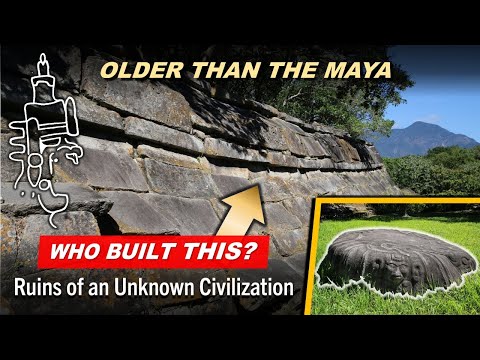 HUGE MEGALITHIC RUINS DISCOVERED in southern Mexico | Las misteriosas ruinas de Tonalá, Chiapas · The ARX Project
Nearby sites
- Olmec Rock Carvings of Pijijiapan74 km
- San Lorenzo Tenochtitlán210 km
- Izapa215 km